



Client Story
Client Story
Client Story







SaaS provider competing with Dolby in the audio tech industry
SaaS provider competing with Dolby in the audio tech industry
This Quiz will help us save 2 million in projected campaign ad spend.
This Quiz will help us save 2 million in projected campaign ad spend.


SaaS provider competing with Dolby in the audio tech industry
This Quiz will help us save 2 million in projected campaign ad spend.


Services Provided
Conversion quiz ecosystem
Services Provided
Conversion quiz ecosystem
Services Provided
Conversion quiz ecosystem

Audience research and message positioning report
Quiz concept, strategy, and copywriting
Landing page and 8 tailored results pages
Post-Quiz Email Sequence with conversion-focused storytelling
Quiz funnel design, setup, and full implementation

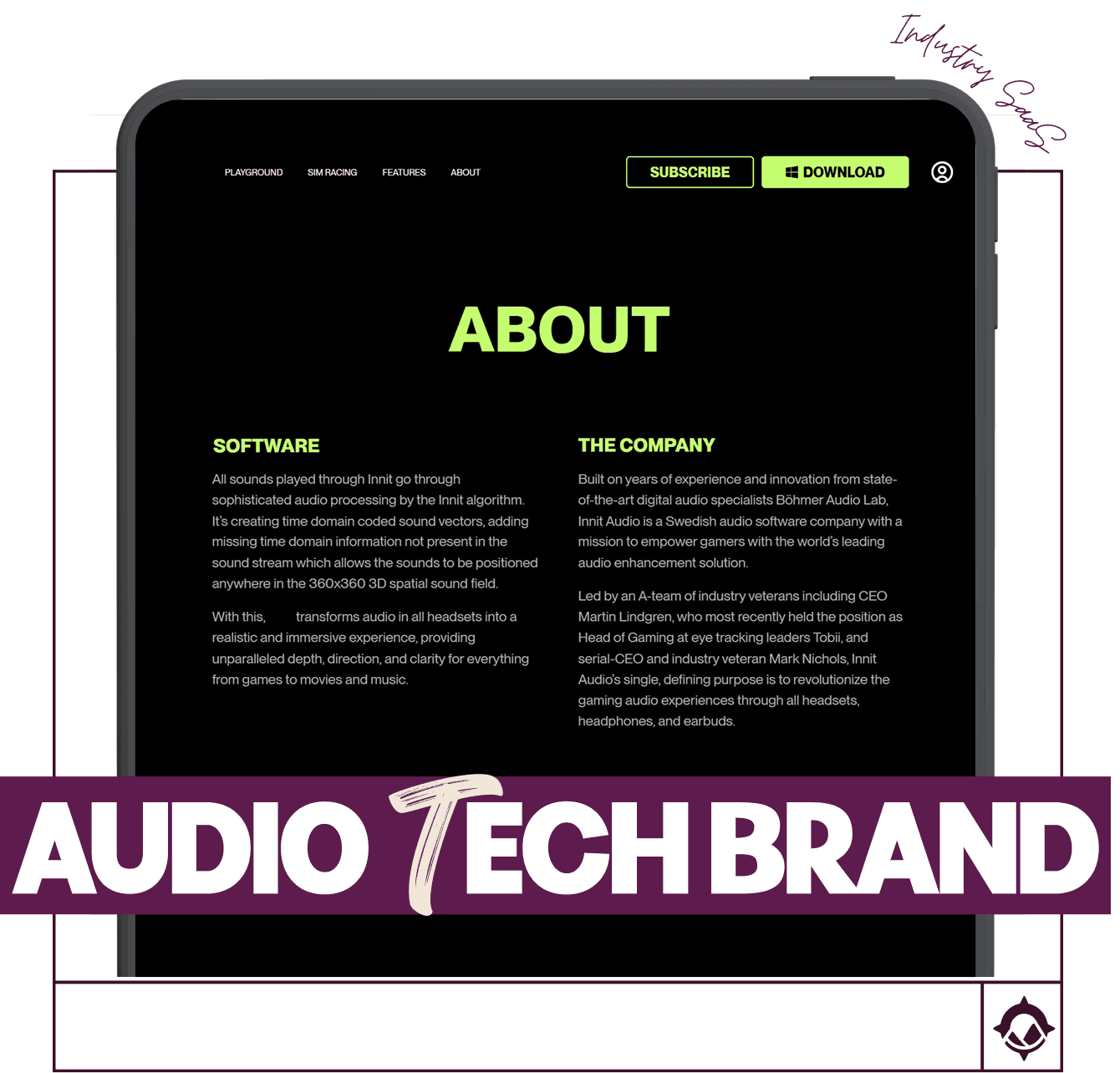

The Client
B2B SaaS Audio Tech Brand
It’s premium gaming audio software that delivers true 3D spatial sound, making in-game audio feel real. Footsteps behind you... wind through the trees… gunfire echoing from a rooftop.
But downloads were only part of the goal. The company wanted major platforms like Apple, Sony, and Xbox to license their technology.
That meant the product’s value needed to be immediately obvious.
Our client’s product promised an experience leagues above category leaders like Dolby Atmos and SteelSeries, without requiring proprietary hardware.
The Client
B2B SaaS Audio Tech Brand
It’s premium gaming audio software that delivers true 3D spatial sound, making in-game audio feel real. Footsteps behind you... wind through the trees… gunfire echoing from a rooftop.
But downloads were only part of the goal. The company wanted major platforms like Apple, Sony, and Xbox to license their technology.
That meant the product’s value needed to be immediately obvious.
Our client’s product promised an experience leagues above category leaders like Dolby Atmos and SteelSeries, without requiring proprietary hardware.

But the product’s real Ambition was
But the product’s real Ambition was
It was needed to be understood clearly enough for licensing discussions with platform teams like Apple, Sony, and Xbox to be realistic, and for investors to immediately grasp where the technology fits and why it matters.
It was needed to be understood clearly enough for licensing discussions with platform teams like Apple, Sony, and Xbox to be realistic, and for investors to immediately grasp where the technology fits and why it matters.
And It Came Together


The Context
When we came on board, we saw that the product itself was stellar. It delivered genuinely immersive, spatial sound. But that strength wasn’t translating into downloads or usage.
The team already had a GTM agency in place to drive traffic to the site.
Traffic was not that big problem at this point.
The issue was what happened after people landed.


Here’s what we observed:

The product demo sat several scrolls down the homepage, meaning many visitors never encountered it.

01
Even when the pricing model was freemium and offered a generous first experience, users weren’t downloading it.
03

The website messaging echoed the same category language used by larger brands like Dolby Atmos and Sony, which led the ICP to question why they should switch from established giants to a startup, even if the product was free.
02
As a result, a product capable of delivering cinematic, spatial audio wasn’t being experienced or understood with the distinction it deserved.
Here’s what we observed:
The product demo sat several scrolls down the homepage, meaning many visitors never encountered it.
01
Even when the pricing model was freemium and offered a generous first experience, users weren’t downloading it.
03
The website messaging echoed the same category language used by larger brands like Dolby Atmos and Sony, which led the ICP to question why they should switch from established giants to a startup, even if the product was free.
02
As a result, a product capable of delivering cinematic, spatial audio wasn’t being experienced or understood with the distinction it deserved.
Here’s what we observed:
400+ products
The product demo sat several scrolls down the homepage, meaning many visitors never encountered it.
01
Space Constraints
Even when the pricing model was freemium and offered a generous first experience, users weren’t downloading it.
03
The website messaging echoed the same category language used by larger brands like Dolby Atmos and Sony, which led the ICP to question why they should switch from established giants to a startup, even if the product was free.
02
As a result, a product capable of delivering cinematic, spatial audio wasn’t being experienced or understood with the distinction it deserved.
Here’s what we observed:
400+ products
The product demo sat several scrolls down the homepage, meaning many visitors never encountered it.
01
Space Constraints
Even when the pricing model was freemium and offered a generous first experience, users weren’t downloading it.
03
The website messaging echoed the same category language used by larger brands like Dolby Atmos and Sony, which led the ICP to question why they should switch from established giants to a startup, even if the product was free.
02
As a result, a product capable of delivering cinematic, spatial audio wasn’t being experienced or understood with the distinction it deserved.


Our client’s product team had already done thoughtful work to define their ideal customer (serious gamers who care deeply about performance, immersion, and a competitive edge).
Where things became less clear was in how the messaging framed the comparison. The positioning assumed gamers were weighing our client’s product against regular stereo sound. But in reality, gamers were benchmarking it against what they already knew and trusted:

Dolby Atmos

Sony 360
HRTF is built into their existing setup
THE POSITIONING GAP
This fab product was being positioned against regular stereo sound. While interviews and ground research showed something different:
Gamers weren’t comparing it to stereo at all.
They already had HRTF-based, advanced audio technologies in their setup.
So they assumed their existing tech was already better. That’s why, even though the product was free, it wasn’t getting attention.
Our client’s product team had already done thoughtful work to define their ideal customer (serious gamers who care deeply about performance, immersion, and a competitive edge).
Where things became less clear was in how the messaging framed the comparison. The positioning assumed gamers were weighing our client’s product against regular stereo sound. But in reality, gamers were benchmarking it against what they already knew and trusted:
Dolby Atmos
Sony 360
HRTF is built into their existing setup
THE POSITIONING GAP
This fab product was being positioned against regular stereo sound. While interviews and ground research showed something different:
Gamers weren’t comparing it to stereo at all.
They already had HRTF-based, advanced audio technologies in their setup.
So they assumed their existing tech was already better. That’s why, even though the product was free, it wasn’t getting attention.

Our client’s product team had already done thoughtful work to define their ideal customer (serious gamers who care deeply about performance, immersion, and a competitive edge).
Where things became less clear was in how the messaging framed the comparison. The positioning assumed gamers were weighing our client’s product against regular stereo sound. But in reality, gamers were benchmarking it against what they already knew and trusted:
Dolby Atmos
Sony 360
HRTF is built into their existing setup
THE POSITIONING GAP
This fab product was being positioned against regular stereo sound. While interviews and ground research showed something different:
Gamers weren’t comparing it to stereo at all.
They already had HRTF-based, advanced audio technologies in their setup.
So they assumed their existing tech was already better. That’s why, even though the product was free, it wasn’t getting attention.
Our client’s product team had already done thoughtful work to define their ideal customer (serious gamers who care deeply about performance, immersion, and a competitive edge).
Where things became less clear was in how the messaging framed the comparison. The positioning assumed gamers were weighing our client’s product against regular stereo sound. But in reality, gamers were benchmarking it against what they already knew and trusted:
Dolby Atmos
Sony 360
HRTF is built into their existing setup
THE POSITIONING GAP
This fab product was being positioned against regular stereo sound. While interviews and ground research showed something different:
Gamers weren’t comparing it to stereo at all.
They already had HRTF-based, advanced audio technologies in their setup.
So they assumed their existing tech was already better. That’s why, even though the product was free, it wasn’t getting attention.

Our first step:
Our first step:
That insight prompted a rethink of the positioning approach. Rather than leading with a pitch, we needed a way to earn attention first and let differentiation emerge naturally.
That insight prompted a rethink of the positioning approach. Rather than leading with a pitch, we needed a way to earn attention first and let differentiation emerge naturally.
Our first step:
That insight prompted a rethink of the positioning approach. Rather than leading with a pitch, we needed a way to earn attention first and let differentiation emerge naturally.
The
The
Audio Tech Brand and Nomads
Audio Tech Brand and Nomads
Collaboration
Collaboration
Collaboration
Collaboration
Collaboration
Collaboration
The
Audio Tech Brand and Nomads
Collaboration
Collaboration
Collaboration

Since the product was free, the goal was to scale freemium users so the company could sell licensing to bigger giants like Apple. A personality quiz was the fastest way to attract high-volume participation.

Since the product was free, the goal was to scale freemium users so the company could sell licensing to bigger giants like Apple. A personality quiz was the fastest way to attract high-volume participation.

We aligned early on that a direct product pitch would be premature.
Gamers were not actively searching for audio upgrades. Our client was also still an unfamiliar name. Trust needed to be built before persuasion could happen.
So we began with a question gamers already ask:
“Which game should you play next based on your gaming personality?”
This choice was grounded in SEO research and common behavior patterns. Many gamers spend hours on Reddit threads and YouTube reviews trying to decide what to play next. The quiz addressed that problem directly.
The landing page did not introduce our client yet. It focused entirely on helping the user.
That choice helped the experience feel like a discovery rather than a lead-gen bait.

We aligned early on that a direct product pitch would be premature.
Gamers were not actively searching for audio upgrades. Our client was also still an unfamiliar name. Trust needed to be built before persuasion could happen.
So we began with a question gamers already ask:
“Which game should you play next based on your gaming personality?”
This choice was grounded in SEO research and common behavior patterns. Many gamers spend hours on Reddit threads and YouTube reviews trying to decide what to play next. The quiz addressed that problem directly.
The landing page did not introduce our client yet. It focused entirely on helping the user.
That choice helped the experience feel like a discovery rather than a lead-gen bait.
We aligned early on that a direct product pitch would be premature.
Gamers were not actively searching for audio upgrades. Our client was also still an unfamiliar name. Trust needed to be built before persuasion could happen.
So we began with a question gamers already ask:
“Which game should you play next based on your gaming personality?”
This choice was grounded in SEO research and common behavior patterns. Many gamers spend hours on Reddit threads and YouTube reviews trying to decide what to play next. The quiz addressed that problem directly.
The landing page did not introduce our client yet. It focused entirely on helping the user.
That choice helped the experience feel like a discovery rather than a lead-gen bait.
We aligned early on that a direct product pitch would be premature.
Gamers were not actively searching for audio upgrades. Our client was also still an unfamiliar name. Trust needed to be built before persuasion could happen.
So we began with a question gamers already ask:
“Which game should you play next based on your gaming personality?”
This choice was grounded in SEO research and common behavior patterns. Many gamers spend hours on Reddit threads and YouTube reviews trying to decide what to play next. The quiz addressed that problem directly.
The landing page did not introduce our client yet. It focused entirely on helping the user.
That choice helped the experience feel like a discovery rather than a lead-gen bait.



We structured the quiz to reposition the product in a category where HRTF and immersive audio already exist, exposing the gap between what players assumed they were experiencing and what was actually possible.
We structured the quiz to reposition the product in a category where HRTF and immersive audio already exist, exposing the gap between what players assumed they were experiencing and what was actually possible.
That contrast created the “aha” moment that made switching feel logical.
That contrast created the “aha” moment that made switching feel logical.
Behind the scenes, quiz responses mapped users to one of eight personas. These personas were grouped under two broad motivations.
Behind the scenes, quiz responses mapped users to one of eight personas. These personas were grouped under two broad motivations.

Competitive players included Vanguard, Champion, and Tactician.
Competitive players included Vanguard, Champion, and Tactician.

Immersive players included Hero, Legend, Warden, Adventurer, and Architect.
Immersive players included Hero, Legend, Warden, Adventurer, and Architect.

We structured the quiz to reposition the product in a category where HRTF and immersive audio already exist, exposing the gap between what players assumed they were experiencing and what was actually possible.
That contrast created the “aha” moment that made switching feel logical.
Behind the scenes, quiz responses mapped users to one of eight personas. These personas were grouped under two broad motivations.
Competitive players included Vanguard, Champion, and Tactician.
Immersive players included Hero, Legend, Warden, Adventurer, and Architect.
This structure was deliberate.

Eight personas allowed the experience to feel specific without over-fragmenting the audience. It balanced relevance with scale.
Each persona was shaped using observed behavior from gaming communities, patterns in play motivation such as adrenaline, mastery, and escapism, and supporting insights from gamer psychology research.
This structure allowed us to surface the hidden gap between what players thought their current HRTF-enabled headset was delivering and what immersive audio could actually unlock, creating the “aha” moment that opened them up to considering an alternative.
This structure was deliberate.
Eight personas allowed the experience to feel specific without over-fragmenting the audience. It balanced relevance with scale.
Each persona was shaped using observed behavior from gaming communities, patterns in play motivation such as adrenaline, mastery, and escapism, and supporting insights from gamer psychology research.
This structure allowed us to surface the hidden gap between what players thought their current HRTF-enabled headset was delivering and what immersive audio could actually unlock, creating the “aha” moment that opened them up to considering an alternative.
This structure wasn’t visible to users up front, but it shaped everything. Under the hood, each answer they chose nudged them toward one of eight personas based on how they play and what keeps them coming back.
The first and most important divide was between competitive and immersive players. We separated them because their definition of “better sound” differed fundamentally.
For competitive players, the value was tactical.
Clearer spatial cues meant hearing enemies earlier and gaining a measurable edge in-game.
For immersive players, the value was experiential.
Richer depth and directional clarity meant feeling more present and absorbed in the world.
This structure wasn’t visible to users up front, but it shaped everything. Under the hood, each answer they chose nudged them toward one of eight personas based on how they play and what keeps them coming back.
The first and most important divide was between competitive and immersive players. We separated them because their definition of “better sound” differed fundamentally.
For competitive players, the value was tactical.
Clearer spatial cues meant hearing enemies earlier and gaining a measurable edge in-game.
For immersive players, the value was experiential.
Richer depth and directional clarity meant feeling more present and absorbed in the world.


By dividing the audience this way, we could position the product differently for each path, highlighting a competitive advantage for one and a deeper immersive experience for the other. This allowed us to personalise messaging according to use-case
By dividing the audience this way, we could position the product differently for each path, highlighting a competitive advantage for one and a deeper immersive experience for the other. This allowed us to personalise messaging according to use-case
By dividing the audience this way, we could position the product differently for each path, highlighting a competitive advantage for one and a deeper immersive experience for the other. This allowed us to personalise messaging according to use-case
By dividing the audience this way, we could position the product differently for each path, highlighting a competitive advantage for one and a deeper immersive experience for the other. This allowed us to personalise messaging according to use-case
To design those personas, we looked at what different types of games offer:
To design those personas, we looked at what different types of games offer:

Adrenaline rush?

01

Strategic kicks?
02

Escapism?
03
And matched that to how players tend to behave.
We pulled patterns from gaming forums, user behavior, and even a psychology study from the ’80s to ground each archetype in real player motivation.
And matched that to how players tend to behave.
We pulled patterns from gaming forums, user behavior, and even a psychology study from the ’80s to ground each archetype in real player motivation.
To design those personas, we looked at what different types of games offer:
Adrenaline rush?
01
Strategic kicks?
02
Escapism?
03
And matched that to how players tend to behave.
We pulled patterns from gaming forums, user behavior, and even a psychology study from the ’80s to ground each archetype in real player motivation.

Smart Profiling
Names such as Tactician and Seeker were based on how people play and why. Every question was short, playful, and designed to segment users with intent without the gamers realizing they were being segmented.

Smart Profiling
Names such as Tactician and Seeker were based on how people play and why. Every question was short, playful, and designed to segment users with intent without the gamers realizing they were being segmented.
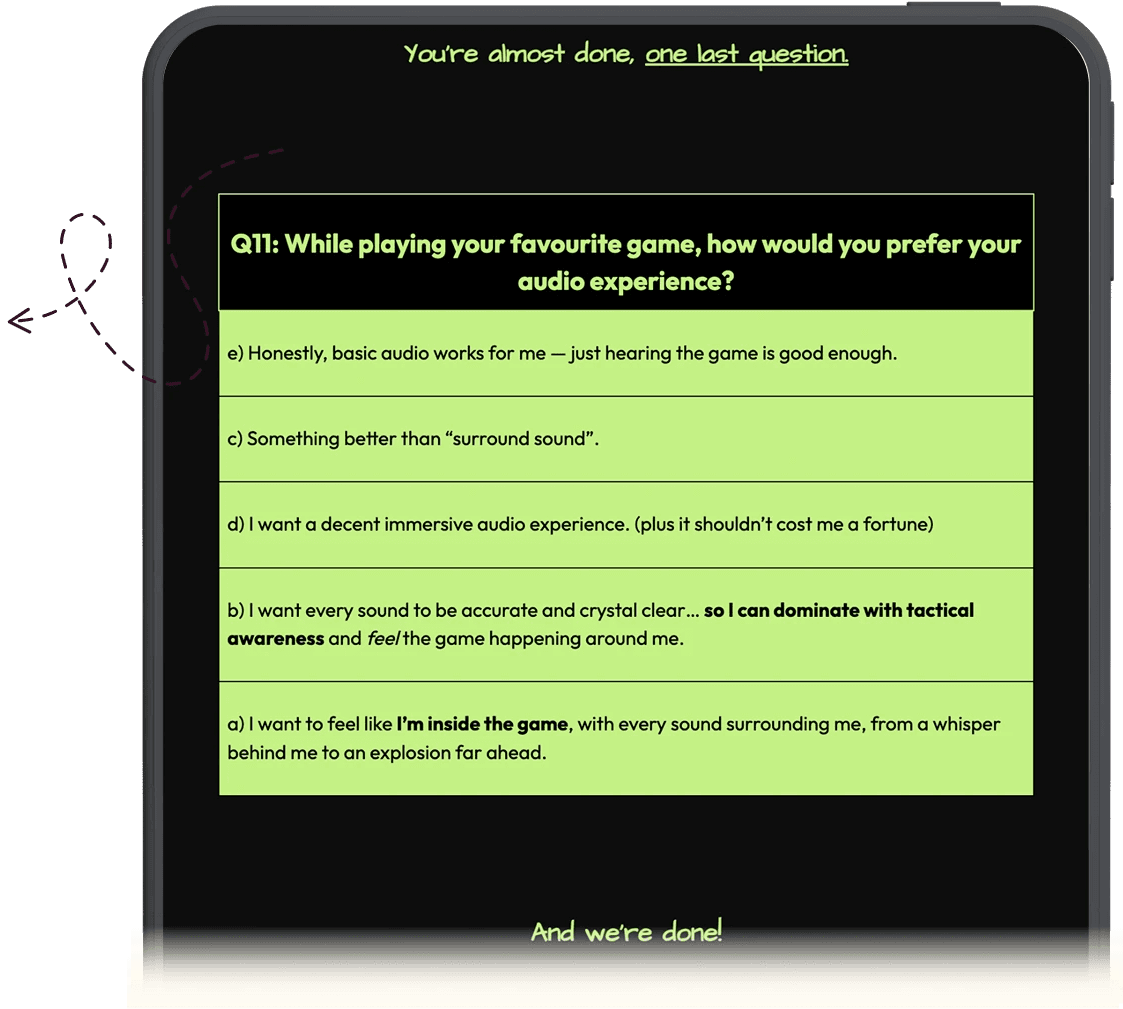
Soft Introduction
And the final question? It quietly introduced the concept of sound immersion, setting up the next part of the funnel.
How we designed the experience
We designed the flow so users don’t feel pitched.
Instead of pushing the product upfront, the questions are built to feel familiar, visual, and curiosity-led. They invited users to reflect on their tastes, preferences, and experiences first, without introducing the product as a “solution.”
This lowers resistance, and encourages more users to complete the quiz.
Soft Introduction
And the final question? It quietly introduced the concept of sound immersion, setting up the next part of the funnel.
How we designed the experience
We designed the flow so users don’t feel pitched.
Instead of pushing the product upfront, the questions are built to feel familiar, visual, and curiosity-led. They invited users to reflect on their tastes, preferences, and experiences first, without introducing the product as a “solution.”
This lowers resistance, and encourages more users to complete the quiz.

By the time players reached the results page, the experience already felt tailored to them. From there, the product was introduced in a way that respected that momentum.
By the time players reached the results page, the experience already felt tailored to them. From there, the product was introduced in a way that respected that momentum.
Each result page is designed to:
Each result page is designed to:


By the time players reached the results page, the experience already felt tailored to them. From there, the product was introduced in a way that respected that momentum.
Each result page is designed to:
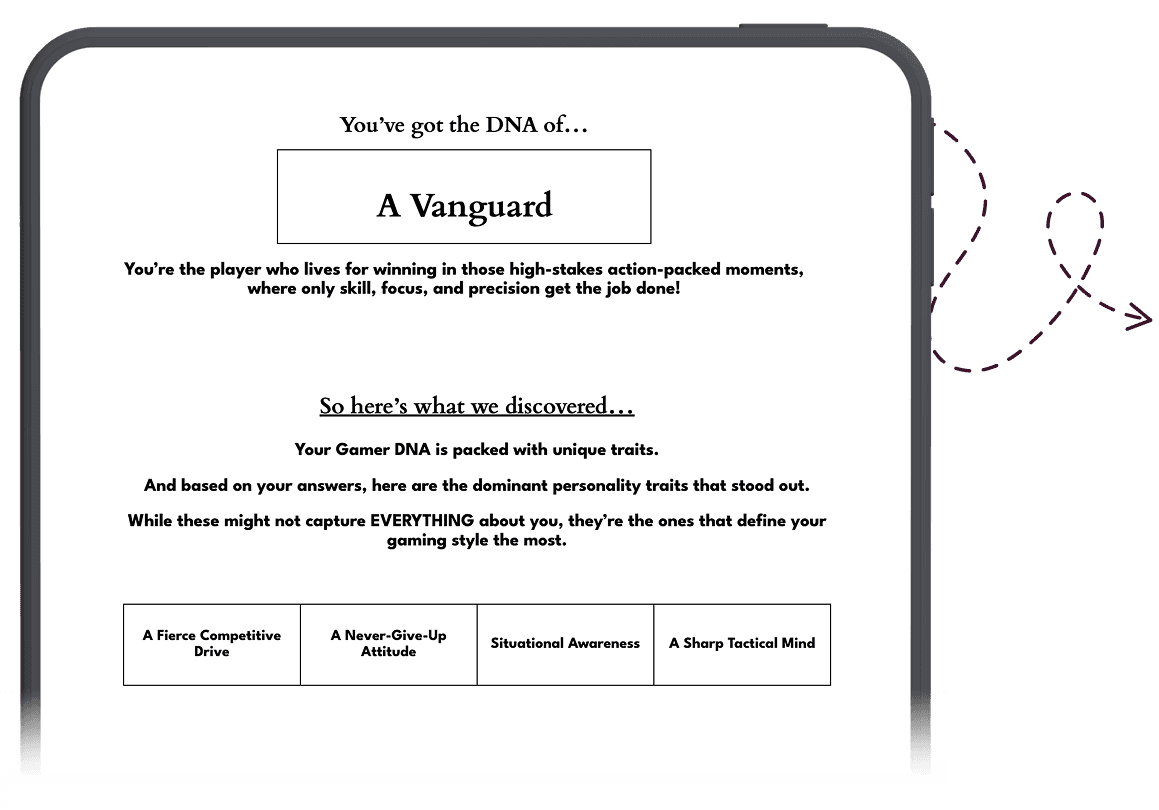
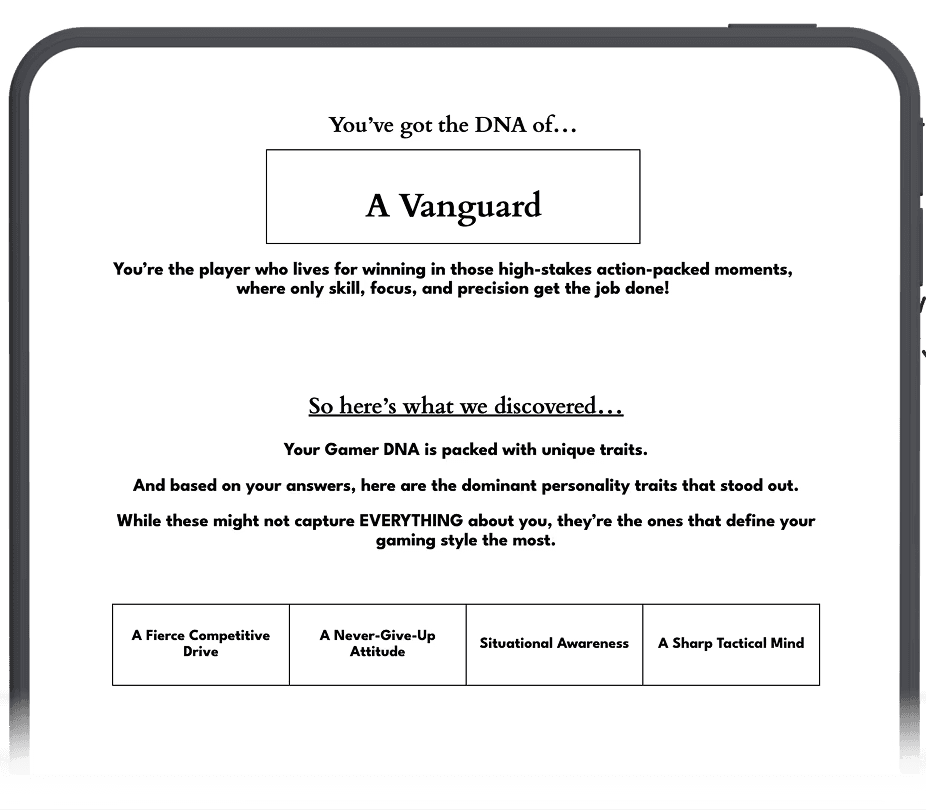
Player Identity
Reflected their gaming style back to them by describing their gaming personality.
Player Identity
Reflected their gaming style back to them by describing their gaming personality.

Smart Recommendations
Recommended games aligned with their preferences with a mix of familiar hits and lesser-known picks tailored to their gaming preferences.

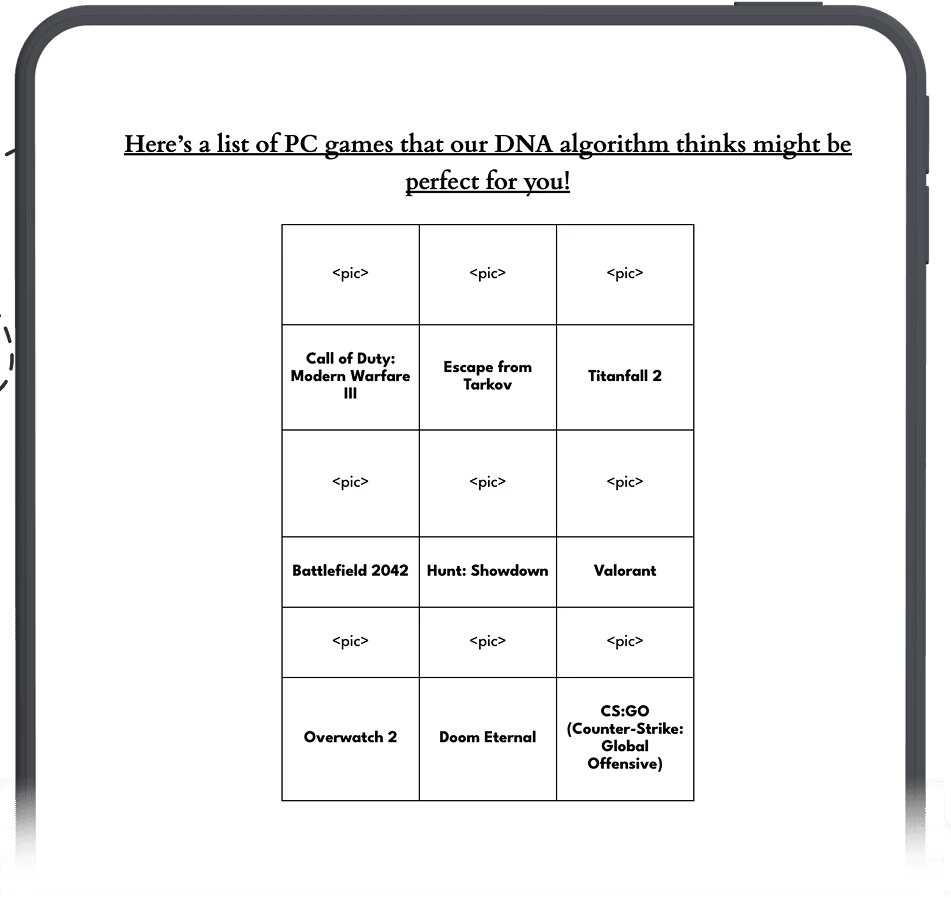
Smart Recommendations
Recommended games aligned with their preferences with a mix of familiar hits and lesser-known picks tailored to their gaming preferences.


Gameplay Shift
A subtle shift in context from “this is the kind of player you are” to “here’s how your gameplay could feel even better.”

Gameplay Shift
A subtle shift in context from “this is the kind of player you are” to “here’s how your gameplay could feel even better.”
Competitive Edge
How the client’s product outperforms Dolby Atmos, Sony 360, and HRTF with thoughtful comparisons so players can clearly see what changes in actual gameplay. This was the core positioning move, doing the job of a PMM team, a lead-gen agency, and a research partner all at once.
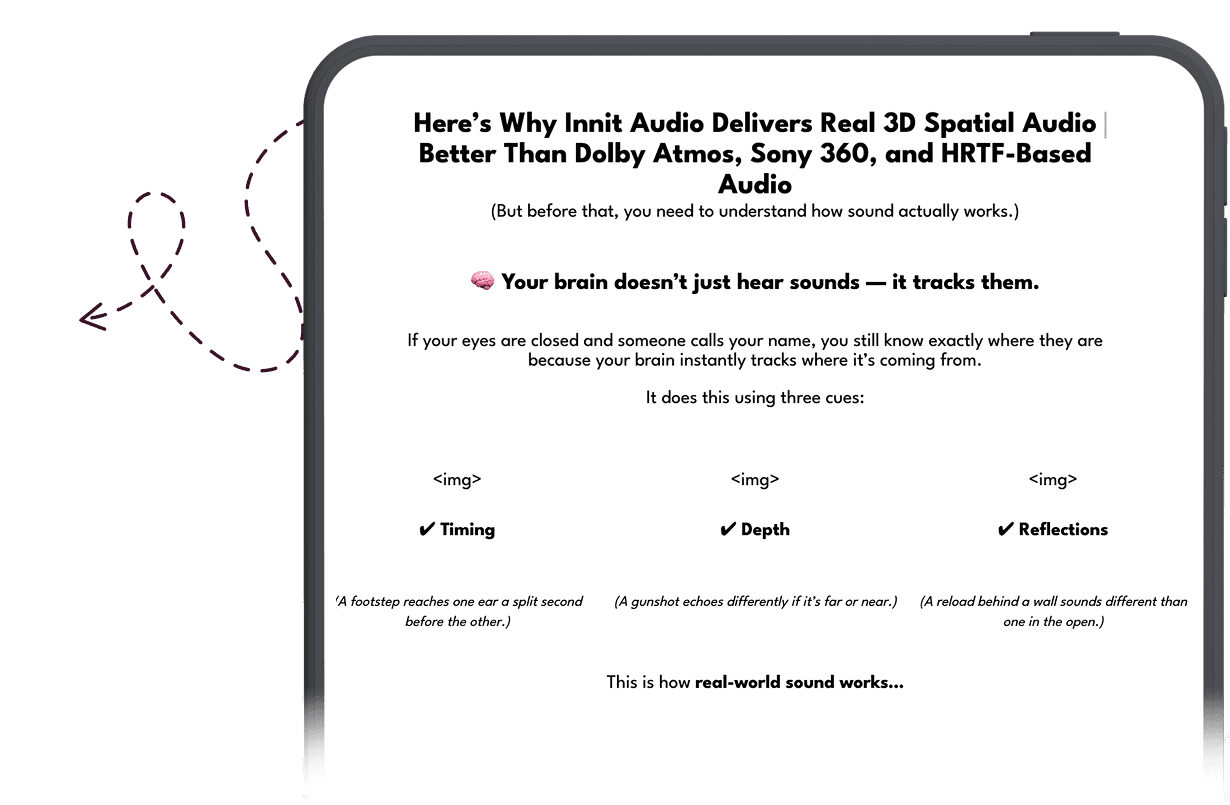
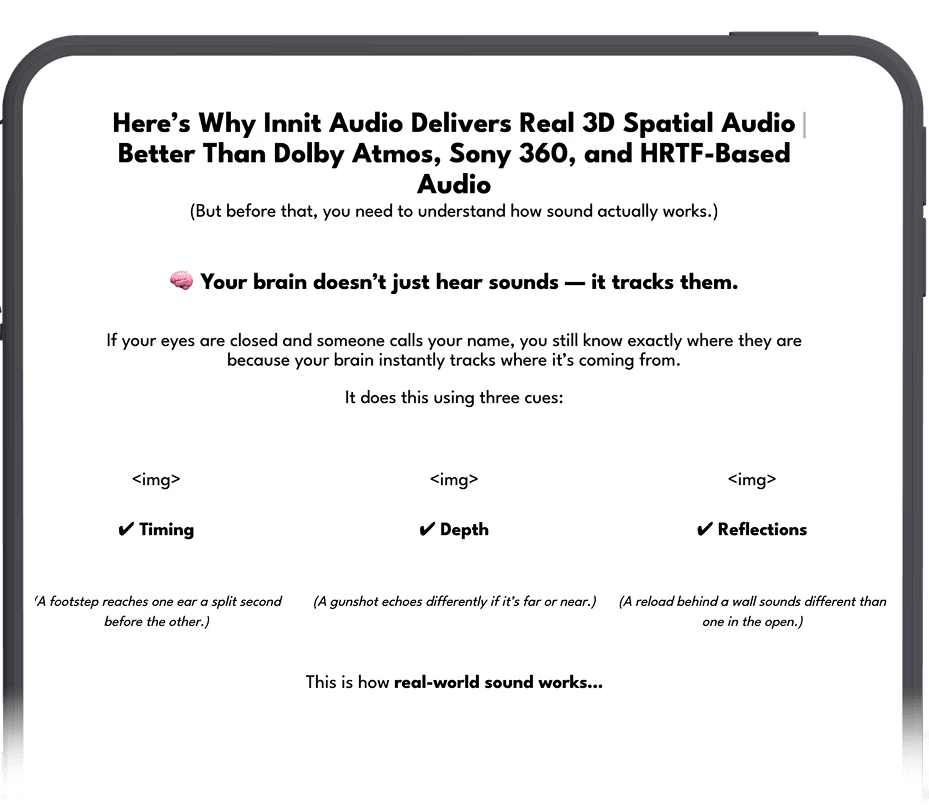
Competitive Edge
How the client’s product outperforms Dolby Atmos, Sony 360, and HRTF with thoughtful comparisons so players can clearly see what changes in actual gameplay. This was the core positioning move, doing the job of a PMM team, a lead-gen agency, and a research partner all at once.


Objection Handling
And we answered the biggest push-backs directly:
“Don’t most games already do this?”
“Isn’t my $300 headset enough?”
And we answered the biggest push-backs directly:
“Don’t most games already do this?”
“Isn’t my $300 headset enough?”
To put it simply, we aimed at just one clear shift in perspective:
Volume effects are great, but our client’s product places sound accurately in the environment, which changes with position, distance, and movement.
That’s the difference our client’s product makes.
Objection Handling
And we answered the biggest push-backs directly:
“Don’t most games already do this?”
“Isn’t my $300 headset enough?”
To put it simply, we aimed at just one clear shift in perspective:
Volume effects are great, but our client’s product places sound accurately in the environment, which changes with position, distance, and movement.
That’s the difference our client’s product makes.

Not every player was ready to download immediately.
So we created a short email sequence to keep the conversation going. Each email focused on just one question. One hesitation. One reason they might not take action yet. The emails address objections raised directly in user interviews, where players explained why they weren’t downloading.

Not every player was ready to download immediately.
So we created a short email sequence to keep the conversation going. Each email focused on just one question. One hesitation. One reason they might not take action yet. The emails address objections raised directly in user interviews, where players explained why they weren’t downloading.
Not every player was ready to download immediately.
So we created a short email sequence to keep the conversation going. Each email focused on just one question. One hesitation. One reason they might not take action yet. The emails address objections raised directly in user interviews, where players explained why they weren’t downloading.
The emails address questions like:

“Isn’t my headset already doing the job?”
“Don’t companies like Dolby and Sony already offer this?”
“How is this different from what I already use?”
Instead of relying on technical specifications, the emails use simple scenarios and storytelling to help players recognize the gap between hearing sound and being immersed in it.
Each email closes with a low-pressure invitation to try our client’s product for free.
The emails address questions like:
“Isn’t my headset already doing the job?”
“Don’t companies like Dolby and Sony already offer this?”
“How is this different from what I already use?”
Instead of relying on technical specifications, the emails use simple scenarios and storytelling to help players recognize the gap between hearing sound and being immersed in it.
Each email closes with a low-pressure invitation to try our client’s product for free.
The emails address questions like:
“Isn’t my headset already doing the job?”
“Don’t companies like Dolby and Sony already offer this?”
“How is this different from what I already use?”
Instead of relying on technical specifications, the emails use simple scenarios and storytelling to help players recognize the gap between hearing sound and being immersed in it.
Each email closes with a low-pressure invitation to try our client’s product for free.


“Isn’t my headset already doing the job?”

Don’t companies like Dolby and Sony already offer this?”


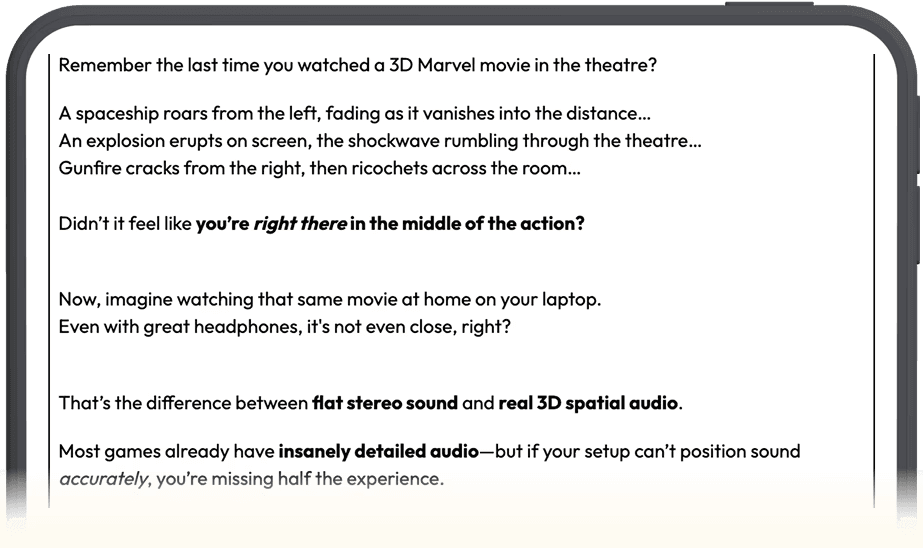
“How is this software any different from what I already use?”
And instead of arguing with facts or piling on features, we told stories.
The tone was casual and clear, a reminder that they were only getting half the experience without 3D spatial sound.





Every message ended with a soft CTA to download our client’s product for free not a direct sales pitch, just an invitation to try it.


This project was about helping a strong product communicate its value more clearly in a crowded category.
Instead of starting with features, we started with the ideal customer’s behavior. We used curiosity, relevance, and a deep understanding of how gamers think to guide them, step by step, toward what they cared about.
By leading with behavior rather than features, the funnel served as a personalized, disguised demo. The product experience was brought forward in a way that felt natural to each player.
Every part of the funnel was intentional.
They were about to scale traffic through their GTM motion and reach thousands more players. But with weakened positioning, more traffic would not have produced more sign ups. It would have amplified a message–market fit problem. Many companies try to fix slow growth by increasing volume. When the message is misaligned, that only drains ad spend and team energy while conversion remains flat.
Instead of increasing volume, we strengthened their positioning. Here’s how:
The eight-persona structure increases relevance without adding friction.
The results pages rebuild belief.
The emails resolve hesitations without force.
The structure we built here is not a one-off ‘thing’. It’s a framework that works for any product team trying to spark interest, build trust, and create traction, especially in categories where attention is hard to win.
This project was about helping a strong product communicate its value more clearly in a crowded category.
Instead of starting with features, we started with the ideal customer’s behavior. We used curiosity, relevance, and a deep understanding of how gamers think to guide them, step by step, toward what they cared about.
By leading with behavior rather than features, the funnel served as a personalized, disguised demo. The product experience was brought forward in a way that felt natural to each player.
Every part of the funnel was intentional.
They were about to scale traffic through their GTM motion and reach thousands more players. But with weakened positioning, more traffic would not have produced more sign ups. It would have amplified a message–market fit problem. Many companies try to fix slow growth by increasing volume. When the message is misaligned, that only drains ad spend and team energy while conversion remains flat.
Instead of increasing volume, we strengthened their positioning. Here’s how:
The eight-persona structure increases relevance without adding friction.
The results pages rebuild belief.
The emails resolve hesitations without force.
The structure we built here is not a one-off ‘thing’. It’s a framework that works for any product team trying to spark interest, build trust, and create traction, especially in categories where attention is hard to win.

This project was about helping a strong product communicate its value more clearly in a crowded category.
Instead of starting with features, we started with the ideal customer’s behavior. We used curiosity, relevance, and a deep understanding of how gamers think to guide them, step by step, toward what they cared about.
By leading with behavior rather than features, the funnel served as a personalized, disguised demo. The product experience was brought forward in a way that felt natural to each player.
Every part of the funnel was intentional.
They were about to scale traffic through their GTM motion and reach thousands more players. But with weakened positioning, more traffic would not have produced more sign ups. It would have amplified a message–market fit problem. Many companies try to fix slow growth by increasing volume. When the message is misaligned, that only drains ad spend and team energy while conversion remains flat.
Instead of increasing volume, we strengthened their positioning. Here’s how:
The eight-persona structure increases relevance without adding friction.
The results pages rebuild belief.
The emails resolve hesitations without force.
The structure we built here is not a one-off ‘thing’. It’s a framework that works for any product team trying to spark interest, build trust, and create traction, especially in categories where attention is hard to win.

This project was about helping a strong product communicate its value more clearly in a crowded category.
Instead of starting with features, we started with the ideal customer’s behavior. We used curiosity, relevance, and a deep understanding of how gamers think to guide them, step by step, toward what they cared about.
By leading with behavior rather than features, the funnel served as a personalized, disguised demo. The product experience was brought forward in a way that felt natural to each player.
Every part of the funnel was intentional.
They were about to scale traffic through their GTM motion and reach thousands more players. But with weakened positioning, more traffic would not have produced more sign ups. It would have amplified a message–market fit problem. Many companes try to fix slow growth by increasing volume. When the message is misaligned, that only drains ad spend and team energy while conversion remains flat.
Instead of increasing volume, we strengthened their positioning. Here’s how:
The eight-persona structure increases relevance without adding friction.
The results pages rebuild belief.
The emails resolve hesitations without force.
The structure we built here is not a one-off ‘thing’. It’s a framework that works for any product team trying to spark interest, build trust, and create traction, especially in categories where attention is hard to win.


“Isn’t my headset already doing the job?”
Don’t companies like Dolby and Sony already offer this?”
“How is this software any different from what I already use?”
And instead of arguing with facts or piling on features, we told stories.
The tone was casual and clear, a reminder that they were only getting half the experience without 3D spatial sound.
Every message ended with a soft CTA to download our client’s product for free not a direct sales pitch, just an invitation to try it.
“Isn’t my headset already doing the job?”
Don’t companies like Dolby and Sony already offer this?”
“How is this software any different from what I already use?”
And instead of arguing with facts or piling on features, we told stories.
The tone was casual and clear, a reminder that they were only getting half the experience without 3D spatial sound.
Every message ended with a soft CTA to download our client’s product for free not a direct sales pitch, just an invitation to try it.


Nomads: Home of the Compounding RPV ™ OS
more revenue per visitor.
Then more again month on month.







Could you add $1.5/M from your existing traffic?
Takes less time than reading a Slack thread. But worth more than your quarterly ad spend.

Alefiya
Khoarki
Nomads: Home of the Compounding RPV ™ OS
more revenue per visitor.
Then more again month on month.
Could you add $1.5/M from your existing traffic?
Takes less time than reading a Slack thread. But worth more than your quarterly ad spend.
Alefiya
Khoarki
Nomads: Home of the Compounding RPV ™ OS
more revenue per visitor.
Then more again month on month.
Could you add $1.5/M from your existing traffic?
Takes less time than reading a Slack thread. But worth more than your quarterly ad spend.
Alefiya
Khoarki
Nomads: Home of the Compounding RPV ™ OS
more revenue per visitor.
Then more again month on month.
Could you add $1.5/M from your existing traffic?
Takes less time than reading a Slack thread. But worth more than your quarterly ad spend.
Alefiya
Khoarki